 The BMW 3-Series features a Manual transmission and Rear Wheel Drive drivetrain on the base model 3-Series. This vehicle has a retail price of $35,300.00 for the base trim package but feel free to view our detailed car options, photos, and more to see if it is worth the price. With such a huge repository of new car research information, it would be difficult to have any more information anywhere online. Buying a new car is a big decision so take your time and research all of the various cars and options. You can even compare similar new cars side-by-side. When you think you have finally narrowed down your choices, be sure to fill out are free, no-hassle, price quote form so you can see what deals may exist in your area.
 Monday, 12 May 2008
BMW 3-Series
The BMW 3-Series features a Manual transmission and Rear Wheel Drive drivetrain on the base model 3-Series. This vehicle has a retail price of $35,300.00 for the base trim package but feel free to view our detailed car options, photos, and more to see if it is worth the price. With such a huge repository of new car research information, it would be difficult to have any more information anywhere online. Buying a new car is a big decision so take your time and research all of the various cars and options. You can even compare similar new cars side-by-side. When you think you have finally narrowed down your choices, be sure to fill out are free, no-hassle, price quote form so you can see what deals may exist in your area. 
Saturday, 10 May 2008
BMW
 Beginning with aircraft engines, BMW AG produced a variety of products in its early years, eventually shifting to motorcycle production in 1923 and automobiles in 1929. The circular blue and white BMW logo, which has not been altered throughout the company's history, does not in fact symbolize a spinning propeller according to a BMW spokesman Joerg Huebner (although the imagery did appear in post-WWI advertisements). The BMW roundel badge is believed to have been partially derived from the logo of its predecessor company Rapp Motorenwerke, while ultimately taking on the colors and checkers from the arms of Bavaria (fusilly in bend argent and azure).[1] BMW's first significant aircraft powerplant was the outstanding BMW IIIa inline-six liquid-cooled engine of 1918, much preferred for its high-altitude performance, and among its successful WWII engine designs were included the BMW 132 and BMW 801 air-cooled radial engines, and the pioneering BMW 003 axial-flow turbojet. BMW's factories were damaged badly in the war, and many surviving machine tools were confiscated by the victorious Allies.
BMW AG bought the British Rover Group (which at the time consisted of the Rover, Land Rover and MG marques as well as the rights to defunct marquees including Austin and Morris) in 1994 and owned it for six years. By 2000, Rover was making huge losses and BMW decided to sell the combine. The MG and Rover marques were sold to the Phoenix Consortium to form MG Rover, while Land Rover was taken over by Ford. BMW, meanwhile, retained the rights to build the new MINI, which was launched in 2001
Cradit : Wikipedia
Sunday, 20 January 2008
Full Test: 2006 BMW M5

Push the start button on the 2006 BMW M5 and there's a slight delay before the engine fires as if to hint at the complexity you're about to set in motion with your finger. And when all 10 cylinders burble to life they give new meaning to the words "performance sedan."
The engine, 5.0 liters of smooth-idling perfection, is capable of more than 8,000 rpm. It typifies the harmony at work in the M5: At idle its creamy smoothness belies its full capability. Like the rest of the car, it is what you want when you want it: relaxed and composed one minute, intense and aggressive the next. It is…balanced.
So throw out your preconceptions. Ignore logic. Forget what you think you know. Then engage the MDrive button and mash the throttle and the M5 will readjust your automotive sensibilities.
Drive it
MDrive, as BMW calls it, changes the M5's character however its driver chooses. It can, at the push of a button, transform the car instantly from a comfortable and quick luxury sedan to a brilliantly balanced, insanely fast road weapon. Technically, you could set everything to change very little, if at all, but when used properly, it increases the M's power output from 400 to 500 horsepower, swaps its throttle response, shift speed and suspension damping to more aggressive settings and disables stability control. Think of MDrive as the M5's Jekyll and Hyde button.
Bump the M button, nudge the paddle, breathe the throttle and we're under way. All at once this is a different sedan from the one we parked last night. Last night it was comfortable, not soft but comfortable, shifted slowly (too slowly), and made some pretty good yank when we stepped on it. It was a banker's car. Or a doctor's car. Dr. Jekyll, perhaps.
Now it's different. Now it's sharp-edged and angry. Delay and hesitation are gone. Every action is met with a deliberate reaction. Throttle jabs in the first two gears will send you to the chiropractor. Expansion joints become speed bumps. Full throttle upshifts — even in a straight line — require countersteer correction. It is immediate. It demands respect. It is Mr. Hyde after a swirly and sugar buzz.
This personality engages serious drivers in ways others in its class never could. This is a car that takes braking, turning, accelerating and hauling passengers seriously.
An engine for the history books
From outside the car, the 5.0-liter V10's sound at idle is tinny and not at all pleasant. The harshness is the reverberation of high-energy exhaust pulses inside the long, stainless-steel manifolds. It's an ugly, abrasive sound uncommon in the world of production engines, where exhaust energy is almost always muffled by cast iron. It's also the sound of BMW's undiluted focus on performance.
Rated at 500 hp at 7,750 rpm and 383 pound-feet of torque at 6,100 rpm, the aluminum engine has a unique power delivery and its combination of sound and thrust are entirely out of place in a sedan. There's no surge of torque when the throttles are opened like in any of the current sports car engines making similar power. Rather, there's a linear wave of thrust that crescendos with an intake shriek which sounds genuinely pissed at its 8,250-rpm redline.
Much of the sound comes from the 10 individual throttle bodies swallowing air through the large plastic intake plenums that cover both banks of cylinders. But the throttles are only the beginning of the technology at work here. There's also VANOS variable valve timing infinitely adjusting the opening and closing of the four lightweight valves at each cylinder.
Other exotica? How about the 12.0:1 compression ratio, hollow camshafts and those ugly-sounding 22-inch exhaust headers. This is an expensive engine. But it makes power and stirs the soul in direct proportion to its cost.
SMG: Round three
A new seven-speed Sequential Manual Gearbox is assigned the duty of transmitting the V10's power to the tarmac and BMW tells us a six-speed manual transmission will be available in the fall of this year. The new SMG, unlike it predecessors, is the first BMW gearbox designed exclusively to operate as such. Designing it from the ground up as an SMG made it stronger and quicker-shifting than previous versions.
Drivers select from two operating modes: sequential or automatic. In sequential mode, gears are selected manually using the steering-wheel-mounted paddles or the shift lever. There are six programs to modify shift speed and clutch engagement in sequential mode. During downshifts in this mode, revs are matched to the selected gear. Requests for a downshift which would overrev the engine are ignored.
Automatic mode, from a user standpoint, is very similar to an automatic transmission in which shifts are made for you. Five shift programs are available in automatic mode and they're all quite slow.
In action it's a blessing and a curse. On its most aggressive setting it lacks subtlety to the point of feeling abusive. Full-throttle upshifts begin with a microscopic pause followed by a violent thud as torque reloads the drivetrain. They're loud, ugly and fast as hell, so be sure you mean it if you're going to do it.
Downshifts, when they're executed as requested, are heavenly. Rev matching is as computer precise as expected. But more often than not when driving hard, they're ignored. Timing downshifts to the predicted rate of deceleration is still not a task suited for street-car technology. We often had to work the downshift paddle two or three times before we got the desired gear.
A chassis dressed to thrill
Visually the M5 stands out from other 5 Series models with double-spoke 19-inch wheels, quad exhaust tips, quarter-panel vents and several minor body changes including a small trunk lid spoiler. It's a subtle freshening that will only be noticed by those keen enough to know it's an M car.
Underneath the M5's skin is a capable all-aluminum suspension design that's up to the task of harnessing this kind of power and weight (4,012 pounds). Conventional MacPherson struts up front and single lower control arms with two upper lateral links at each side make up the rear suspension.
Damping is electronically adjustable in one of three modes: "Comfort," "Normal" or "Sport" via BMW's Electronic Damping Control, which continues to adjust damping to suit road conditions within each mode. The ride, even in Comfort mode, is exceptionally well controlled. The Normal setting provides an aggressive ride and Sport is stiff enough to only be useful on a glass-smooth racetrack.
The M5's steering ratio is variable and quickens as the wheel is turned off center. Steering assist is also variable between two levels which are linked to the car's electronic damping modes. In Comfort mode more steering assist is available than in Normal or Sport modes. Steering feel is typical BMW, with sharp off-center response and a just-right soft spot on center so as not to feel nervous when cruising. It's an appropriate balance for a car like this.
Naturally, BMW's most advanced braking system graces the M5. Behind the 19-inch wheels are huge 14.7-inch front and 14.6-inch rear two-piece rotors bringing the big sedan to a stop. Surprisingly, there are no four-piston calipers hiding in the front wheels. Instead, BMW chose a far less sexy dual-piston sliding-caliper design.
Power is sent to the Continental SportContact2 tires through BMW's M Variable Differential Lock limited-slip rear differential. Torque is distributed evenly between the rear wheels when viscous fluid in the clutch-type differential is sheared by a difference in wheel speed. In action, it's a quick-reacting, natural-feeling torque distribution that spreads rubber on pavement like butter on toast.
Control room
Overall, with its combination of leather, satin aluminum or wood trim and iDrive, the M5's interior is a distinctly Bavarian balance of form and function. Because iDrive controls navigation, climate, stereo and communication settings, the dashboard is relatively uncluttered. Switches on the center console control engine output, suspension modes and all 11 SMG calibrations.
The optional 18-way adjustable heated seats in our test car were equipped with active backrest bolsters which move inward to brace the driver or passenger against cornering loads. They are a gimmicky feature that can distract at critical moments. Luckily they can be switched off. We'd make due with the standard heated seats which are only 16-way adjustable.
The thick-rimmed leather steering wheel is stitched with red and blue and serves as the perfect frame for the easy-to-read 200-mph speedometer and 9,000-rpm tachometer. There's also a head-up display which projects engine speed and gear selection into the lower portion of the windshield, but we could never find it at a glance.
How's it stack up?
This is a very different car from the Cadillac STS-V or Mercedes-Benz E55 AMG, its only obvious competitors. Both of those cars are powered by grunty, supercharged V8 engines that, when compared to the M5's high-revving V10, feel like they belong in a tractor. This unique power delivery endows the M5 with more edge and involves its driver more than a lower-revving engine.
The M5 is also faster than the Cadillac and on par with the E55 in virtually any contest of speed. Our test car plowed through the quarter-mile in 12.8 seconds at 115 mph — a full half-second quicker than the comparably priced Cadillac. It hit 60 in 4.8 seconds, slightly slower than BMW's claimed time of 4.5 seconds. Our test surface isn't known for its grip, and without the aid of launch control, which isn't available on U.S.-spec M5s, launching the car is a trial-and-error procedure.
Perhaps most impressive was the M5's 69.2-mph slalom speed, which trumps the Cadillac by exactly 4 mph — no small margin in this test. Surprisingly, it generated only 0.86g around the skid pad, a number that doesn't reflect its capability.
Braking distance from 60 mph was outstanding at only 112 feet — 10 feet shorter than the Cadillac. Pedal feel was initially solid and confidence inspiring, but we did notice very slight fade after five back-to-back stops.
Is it for you?
Learning the M5's nuances, the ins and outs of its various systems and its ridiculous number of adjustments, is a serious task. And it comes with a serious price. Our test car totaled $89,090 with options and the mandatory gas-guzzler tax.
The M5 is one hell of an advanced car and it will challenge anyone who approaches driving like a conventional enthusiast. Most of the time it's brilliant and more than capable of meeting its driver's requests for power, grip or comfort. But get lazy — leave the tranny in 7th gear then mash the throttle for a quick pass on a back road — and the SMG's brilliance fades as fast as the oncoming headlights loom. No amount of technology will save you from idiocy in manual mode.
The 2006 BMW M5 isn't just a sedan. And it isn't just a performance car. It's a new breed of machine that defies definition. It's a 500-hp four-door that's equal parts passion, performance and highfalutin utility. Like we said…balanced.
Credit By Josh Jacquot, Senior Road Test Editor
Full Test: 2000 BMW M5
There's a glass ceiling in the automotive world when it comes to what you get in relation to what you pay for. The BMW M5 is slammed up hard against that ceiling and we think paying more for any new car is a foolish waste of money. Put another way, spending more than the approximate 75 grand needed to acquire an M5 is where the law of diminishing return begins in terms of all things automotive.Case in point when looking at the highest echelons of four-door super-luxury sedans: Why would anyone spend 200 or 300 bills on a car like a Bentley or a Rolls Royce when the M5 is so much better than anything at any price that it makes the car a screaming bargain in the process? It just ain't worth it and that's why we look at the M5 as the ultimate car of any type — especially when you factor in what the M5 costs and what you get for that price.
Before we get into why the M5 is on the razor-sharp edge of this spectrum, a comprehensive overview of this amazing machine is clearly necessary. The first-ever V8 in any BMW M car, the M5's 5.0-liter (at 4941 cc, it's really a 4.9-liter) powerhouse is probably the most spectacular engine available in any car today. Based on the M62, 4.4-liter DOHC mill in the 282-horsepower 540i, the M5's engine is designated the S62.
While the basic architecture is similar, the M5's engine is entirely unique. Using the hot-rodders magic dust that's known as stroking, the M5's engine has an increased stroke from 82.7 millimeters to 89 (or in standard terms 3.50 inches). The M5's aluminum block is a specific casting. Its 94-millimeter (3.70-inch) cylinder bores are also slightly larger compared to 92 millimeters in the 540i. An increased stroke is the shortest path to more torque and the M5 delivers in 500 cubic-inch, American big-block V8-type portions.
The longer-stroke crank moves oil-cooled pistons specific to each cylinder bank. The cooling is achieved via two separate oil passages in the crankcase. Compression is 11:1 — a full point higher than the 4.4-liter in the 540i.
The M5's engine oiling system is as exotic as the rest of the motor's innards. Sensitive to the high cornering ability the car is capable of achieving, engineers deemed that natural return of oil to the oil-pan sump would be inadequate during extreme cornering. Therefore, two scavenging pumps, one for each cylinder bank, are utilized. In normal driving, these pumps pick up oil from the rear of the engine and return it to the sump. During hard cornering (0.9g or more) the Dynamic Stability Control (DSC) system's lateral-g sensor switches magnetic valves to different pickup points at the outer side of the oil pan. This system remains active even if the driver switches off DSC. A thermal sensor monitors oil level and temperature and a warning appears in the "check control" display if the level falls below a certain point. Replacing the fuel-economy gauge found in many BMWs, the M5 has an oil-temperature gauge in the tach face. Additionally, oil is cooled by a coolant-oil heat exchanger, the first-ever application of this on a gasoline engine.
Moving up from the engine block, the M5's cylinder heads are also updated from the 540i with more efficient cross coolant flow and larger intake ports. Although the 35-millimeter intake and 30.5-millimeter exhaust valves are the same as the 540i, the M5 has more aggressive cam profiles, another element contributing to its prodigious power output.
On top of the massive amounts of torque supplied by the increased stroke and cylinder-head modifications, the S62 breathes like a wild fire fanned by a giant bellows. A special induction system takes air in at two points behind the front bumper, passes it through two intake silencers and into a pair of mass-air meters before heading into a carbon-fiber plenum on top of the DOHC cylinder heads. From there, air travels through 230-millimeter intake runners to the cylinders. The plenum and runners are attached to the throttle housings by a rubber/metal flange that separates the plenum from the engine itself, thereby keeping the air charge cooler before it goes into the cylinders.
Air going into the cylinders isn't through a single throttle body as it is on almost all automotive street engines, but rather through eight separate throttle butterflies that are controlled electronically when the driver presses the accelerator pedal. A separate throttle butterfly for each cylinder is usually found only on purpose-built racing engines. Previous M car inline sixes, like those in the M1, earlier M5 and M6, had a similar setup, but none of those were electronically actuated.
Of course, these separate 50-millimeter throttle butterflies are much closer to their respective cylinders than a single unit could ever be, so air flow lag times are eliminated and the engine ends up having much improved throttle response.
The fly-by-wire system operates thusly: The driver give commands with the accelerator pedal to two potentiometers which move each throttle butterfly operating in its own housing mounted directly at the intake ports. As the driver moves the gas pedal, the commands are calculated by the engine's computer processor and received by a DC servomotor between the cylinder banks. In turn, through a small gearbox, this motor drives a shaft that drives a link to each cylinder bank to rotate the throttle butterflies of that bank.
These two links rotate the throttle shafts, connecting via balljoints at cylinders 3 and 6. From these points, the other three throttle butterflies are opened and closed and the servomotor reacts to any pedal movement in a light-speed-like 120 milliseconds. The result is the driver perceives no lag time — only instant throttle response. Furthermore, the M Driving Dynamics Control System, controlled by a switch on the dash, provides two settings for throttle response: normal and an even quicker sport mode. In addition, the throttle butterflies for cylinders 4 and 8 have their own feedback sensors to monitor operation. If a fault is recognized in the system, one of four limp-home modes allows operation of the car at speeds of up to 62 mph.
Besides the engine, oiling system, cylinder heads, intake system, and throttle control, there's yet more wizardry hidden under the bonnet of the heroic M5. The final piece of the M5's powerplant puzzle is Double VANOS steplessly variable valve timing. The VANOS acronym refers to variable cam control or variable valve timing (in German — VAriable NOckenwellen Steuerung). Double VANOS is employed on a BMW V8 for the first time in the M5. It steplessly varies the timing of both intake and exhaust valves on both cylinder banks. While current BMW 2.5- and 2.8-liter inline sixes also have the Double system, the 4.4-liter V8 used in the 540i, 540iT, 740i/740iL and X5 have a Single VANOS system that only varies intake-valve timing. In addition to more low- and medium-speed torque output, the advantages of VANOS are numerous. Even before the car is moving, you get reduced unburned hydrocarbons during idling, smoother idling, internal EGR (exhaust gas recirculation) at low speeds for improved control of nitrogen oxides (NOx), quicker warmup of catalytic converters after cold start (thereby reducing emissions during this operational phase), and reduced combustion noise.
As with other BMW engines, the VANOS mechanisms are at the front of the cylinder heads. Dedicated oil pumps provide the 1450 psi of hydraulic pressure used to actuate VANOS with one per cylinder head. Furthermore, valve timing is varied over a range of a full 60 degrees in terms of crankshaft rotation, a wider adjustment range than on any other BMW engine.
The S62 also uses a unique Bosch Motronic engine control system dubbed the MSS 52. In addition to controlling basic engine functions, this processor oversees the electronic throttle system (including cruise control and DSC), the engine's g-sensitive lubrication system, the thermal oil-level sender, catalytic-converter protective functions, Double VANOS, a 7,000-rpm rev limiter, and the M Driving Dynamics Control which provides two settings for the throttle system and power steering.
The Motronic also administers a variable tachometer-warning zone that reminds the driver that a cold engine should not be driven hard. When the engine is first started, the "yellow" line indicated by orange LEDs begins at 4,000 rpm. As the engine warms up, the LEDs turn off to lift the limit in 500-rpm increments until the normal limit begins at 6,500 rpm. The actual redline is 7,000 rpm.
The result of all these cutting-edge mechanicals is no less than the world's most powerful four-door sedan as the M5 makes an even 400 horsepower at 6,600 rpm and 369 foot-pounds of torque at a low 3,800 rpm. There isn't a four-door car on earth that can touch it.
The M5 isn't available with an automatic transmission. Its Getrag six-speed is the same basic unit as found in the 540i, but with a strengthened self-adjusting clutch. With a stump-pulling 4.23:1 low gear, fifth is 1:1 and the overdriven sixth is 0.83. The final-drive ratio in the limited-slip rear differential is 2.81:1.
The M5's chassis is as equally dazzling as its drivetrain mechanicals. Mostly based on the 540i six-speed, the M5 has firmer shocks and springs and low-friction steel balljoints that replace rubber bushings at the outboard ends of the rear suspension's upper arms.
The quick-ratio power steering has a 14.7:1 overall ratio and M Servotronic power assist. Compared to the engine-speed-sensitive variable assist of lesser 5 Series cars, the M5's system varies power assist according to vehicle speed. The system is calibrated for a firm road feel and the recirculating-ball steering gear has an automatic pressure-point adjustment that eliminates free play in the straight-ahead position. The result is precision comparable to that of rack-and-pinion steering while retaining what BMW says is the superior suppression of road shocks offered by the recirculating-ball mechanism.
Put all this rather awe-inspiring technical prowess together and you get a driving experience that's on the same level: awe inspiring. An editor took our LeMans Blue test car home one evening and surmised this: "There are no superlatives to describe how close to perfect the M5 is for the serious driving enthusiast. Take everything ever uttered or written about a BMW, magnify it 10 times, and then apply it to this car."
Most of our staff felt the same way. On deserted stretches of lonely two-lane, the M5 is pure fantasy pulling up to and blasting through triple-digit speeds like a cheetah chasing down its prey. Massive amounts of big-block-style torque are available at any engine or vehicle speed, in any gear - remarkable for a motor barely displacing more than 300 cubic inches. It almost feels as if the faster you go, the harder the engine pushes you to license-endangering velocities.
Besides the warp-drive-like thrust of the M5's powerplant, its chassis dynamics are equally enthralling. Over twisty back roads and hairpin curves, the M5 is simply infallible in its ability to go, stop, turn and grip. Despite its hefty 4024-pound curb weight, the M5 is as much at home on a racetrack as it is in the valet-park at any city's most exclusive watering hole.
In fact one editor placed the M5's capabilities beyond some of the most sporting two-seaters, citing that it goes about its business "like nothing I've ever driven before, including a C5 Corvette, an Acura NSX and the often-rickety Dodge Viper."
Staffers who cycled in and out of the car also noticed another trait of the M5 so extreme that no other car we've ever driven comes close. It might even be somewhat of a bad thing — at least in terms of the legal standing of one's driving record. The car is so competent that it lulled everyone who drove it into believing that 80 mph on a four-lane highway equates to a mellow Sunday drive puttering along like an old man. One editor related, "I literally had to force myself down to 65 mph (in a 55 zone) and set the cruise control to keep from getting arrested by the local gendarmes."
Although the M5's look is so subtle that most mistake it for a standard 540 or even a 528, we still had a blast playing head games with those who think they might've had a leg up on us in such cars as a Porsche 911 or a Corvette. One editor who had a particularly good time with snooty 911 drivers noted, "It's great (and a little weird) driving a sedan with leather seating, decadent luxury, satellite navigation and scads of other features while simultaneously seeing Porsche 911s on the road and thinking 'I'm faster than you. Your car ain't s--t.'"
Picking on unsuspecting Porsche drivers and pilots of other seemingly high-powered machinery aside, our M5 proved to be a bit fickle at the test track when it came to generating outright stellar quarter-mile times. It should be noted, though, that neither the car nor the driver was at fault. Rather, the track's somewhat greasy conditions contributed to slower-than-expected performance. But even though our mid 13-second quarter-mile times were a few tenths off the car's 13.3-13.2 second capabilities, the trap speeds clearly communicated that our car was as strong as any M5 that's been tested by anyone else. We recorded consistent speeds of 105 mph on our way to a best e.t. of 13.75 seconds at 105.7 mph. We also pedaled (and we do mean pedal in first and second gear) the M5 to 60 mph in 5.28 seconds. As expected, the M5 excelled in braking and skidpad testing, too, stopping from 60 mph in a scant 116 feet and circling our 200-foot diameter pad with .90 g of lateral grip. Top speed is electronically governed to 155 mph, but BMW has said that with no governor, the M5 would probably be good for up to 180 mph.
But hard test numbers tell only a fraction of what this car is all about. We see the M5 as a convergence of all the best a car can offer. It has performance on par or beyond that of a C5 Corvette or 911 combined with four doors, room for five, a real trunk with 11.1 cubic feet of carrying capacity and rock-solid build quality. One editor likened the M5 to a sports car with capacity to carry people and cargo. He further noted that, "Unless you're sold on a Boxster S or Corvette's looks, and if you've got the dough, the M5 makes a far more practical performance machine." In most ways the M5 is just about a perfect car.
But not quite. While the M5's flaws are just about exclusively confined to inside the car — and none really have anything to do with how this Bimmer actually drives — they are still notable and in some instances, almost annoying. A number of staffers thought the gauges were on the small side and the steering wheel rim also obscures the tops of them. Some drivers felt the DSC system was too intrusive during spirited driving — shutting it off would cure that. A problem with all current BMWs: to shut off the HVAC fan you have to click the control switch numerous times. Other nitpicking could include an uncomfortable center armrest, control markings on the dash that are difficult to decipher, and the navigation system that takes too long to update your location when you're simply tracking the car's position on the map.
Otherwise, the interior is a model of comfort and civility. With 16-way heated power seats, everyone who drove the car was able to find an ideal setting to concentrate on piloting this rocket ship. One staffer was happily able to find a "perfect driving position with adjustable lumbar and a myriad of seating positions."
The only gripe related to driving the car concerns the clutch. One driver noted that at times it was "heavy with an abrupt engagement point that proved to be a hassle in traffic."
Sure, one can carp about such frivolities like clutch engagement, but we'd say that particular editor can take a long walk. The M5 is the world's finest sedan with stunning acceleration, eye-popping grip, anchor-imitating brakes, ballerina-like chassis dynamics, decadent luxury, and people-and-stuff moving practicality all rolled up into subtle but aggressive and purposeful-looking bodywork. At any price, this car, to take a page from a Jack Nicholson movie, is "as good as it gets."
credit By Miles Cook Email By Scott Memmer Email Date posted: 01-01-1999
BMW - M5
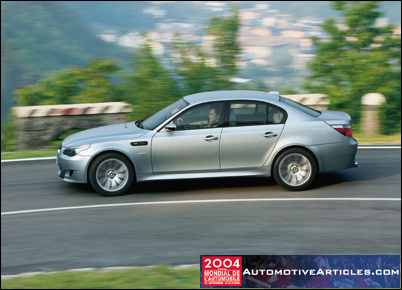 A consonant and an odd number: M5. Simple enough, yet these two digits hold enough power to make just about any red-blooded car enthusiast mess himself. The previous generation M5 with its superb V8 and six speed manual transmission was, simply put, the ultimate sports sedan in the world. With its balance of refined luxury and its ability to embarrass the owners of some exotic sports cars, the M5 has definitely earned its place in the automotive hall of fame. If you were BMW, how would you go about replacing this modern legend?
With a big old V10, that’s how! You also get controversial American designer Chris Bangle’s team to add a bit of lipstick to an already debate-provoking design. But screw what it looks like, let’s talk power. The new M5, according to the company, is the most powerful production vehicle in the BMW lineup. Considering this is a family of vehicles that don’t exactly have any problems in the power department, to be at the top of this gene pool is quite a feat. How much so, you ask? Think 507hp and 384 ft-lbs of torque out of this 5.0L beast with an 8,250rpm redline. That’s an increase in performance by over 25%, not to mention that this V10 tops the oh-so-wonderful 100hp per liter mark.
Lets talk nuts and bolts for a moment. The V10 features two banks of five cylinders arranged at a 90 degree angle with a crankshaft drive optimized for lower vibration and improved comfort. Because of the stress owners are expected to place on this engine, BMW went with a bedplate design for the crankcase – a first for any of the company’s production V engines. Grey-cast iron inserts are integrated into the aluminum bedplate to improve acoustics and ensure high oil flow. The high-strength crankshaft is supported by six bearings. BMW’s bi-VANOS variable valve timing system keeps emissions in check despite the engines high performance tuning. Each cylinder has its own throttle, the control of which is electronic and cylinder bank specific.
The exhaust system is made of seamless stainless steel with a dual-flow design all the way to the mufflers, where they exit out through M-trademark four tailpipes. In the United States, the M5 is expected to meet LEV2 emissions standards. Ionic current technology is used by the engine management unit to detect engine knock, misfiring, and combustion misses. Essentially, the system uses the spark plug as an actuator for the ignition and as a sensor for monitoring the combustion process.
Replacing the previous M5’s six-speed manual will be an all-new seven-speed (the world’s first) sequential gearbox, aka SMG. Considering the V10’s high-revving nature, the short-spaced shift times should allow the driver to wring the most out of this sedan’s 8,250rpm redline. This being an SMG transmission, an automatic-shift feature will be available for those times when you’re sitting on the 10 freeway, crawling your way into Los Angeles (which Southern Californians know is, basically, every day). As good as the SMG may be, you can imagine some diehards are lamenting the loss of a true manual transmission. However, when this beast goes from 0-62mph in 4.7 seconds (according to BMW), who really gives a damn? The 124mph mark is reached in a very quick 15 seconds while the top speed is an electronically-limited 155mph. BMW boasts the M5 could top out at 205mph if it wasn’t for the damn computer. Paging big, angry mob: Bill Gates needs you in room 5. Thanks.
As is all the rage these days, the new M5 has been tested on (and designed with input from what was learned on) the north loop of the legendary Nurburgring race track in Germany. The results are lap times of around 8 minutes. It should be noted that all M vehicles have been tested here, not just recent ones. Note to Cadillac, this one’s for you. Though this is essentially a 5-series on crack, no one will be able to say that this is just your ordinary 525i. All of the handling systems and electronic assistants have either been exclusively designed for the M5, or substantially redesigned from their more plebian roots.
For starters, there’s an exclusive variable, torque-sensing differential lock for optimum traction, especially coming out of corners. BMW’s Dynamic Stability Control (DSC) comes with two selectable driving styles: one similar to the typical 5-series, and the M Dynamic Mode that allows for sporting maneuvers while still standing by to save your sorry ass should things get a little out of control. Of course, DSC can also be deactivated at the press of a button. Likewise, the M5’s Electronic Damper Control (EDC) allows the driver to select three levels of electronic suspension tuning (comfort, normal, sport) – no longer does buying a sports car mean a constant kidney pounding ride. Unless, of course, you like that kind of stuff. The large brakes and twin-piston sliding calipers (similar to those in the 7-series) are expected to bring the M5 from 62mph to 0 in under 36 meters.
Exclusive M5 design details include revised front, rear, and side treatments along with the M-typical new side mirrors, quad exhaust tips, and large wheels. Like the M3, the M5 now sports “gills” incorporated into the front side fenders. The interior features new leather colors, a new steering wheel, new center instrument panel treatments, and new gauges. In the end, it’s going to come down to whether or not you like Bangle’s style – no amount of M dress-up is going to save the 5-Series’ design if you hate it already. Likewise, if you love it, this will likely only make you even more infatuated.
Whatever you think about Chris Bangle, iDrive, and the rest of the “new” BMW lineup, the M5 is still a force to be reckoned with. To some, it may not have that classically aggressive look of past, but it’s certainly got the balls to back up its unique looks. I started this article writing about a letter and a number. I’ll end it with another letter and two more numbers. V10. That’s all that matters.
credit By Mike Cervantes
Saturday, 8 December 2007
BMW - M5
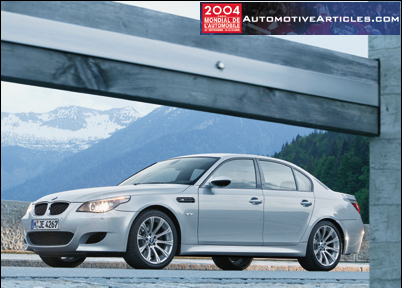 A consonant and an odd number: M5. Simple enough, yet these two digits hold enough power to make just about any red-blooded car enthusiast mess himself. The previous generation M5 with its superb V8 and six speed manual transmission was, simply put, the ultimate sports sedan in the world. With its balance of refined luxury and its ability to embarrass the owners of some exotic sports cars, the M5 has definitely earned its place in the automotive hall of fame. If you were BMW, how would you go about replacing this modern legend?
A European Diary : 2004 Paris Motor Show
Last Updated: Aug 16th, 2006 - 11:01:00
Paris2004: V10 Powered BMW M5By Mike CervantesOct 17, 2004, 22:07
Email this article Printer friendly pageDiscuss this story
BMW M5. Courtesy: BMW AGA consonant and an odd number: M5. Simple enough, yet these two digits hold enough power to make just about any red-blooded car enthusiast mess himself. The previous generation M5 with its superb V8 and six speed manual transmission was, simply put, the ultimate sports sedan in the world. With its balance of refined luxury and its ability to embarrass the owners of some exotic sports cars, the M5 has definitely earned its place in the automotive hall of fame. If you were BMW, how would you go about replacing this modern legend?
With a big old V10, that’s how! You also get controversial American designer Chris Bangle’s team to add a bit of lipstick to an already debate-provoking design. But screw what it looks like, let’s talk power. The new M5, according to the company, is the most powerful production vehicle in the BMW lineup. Considering this is a family of vehicles that don’t exactly have any problems in the power department, to be at the top of this gene pool is quite a feat. How much so, you ask? Think 507hp and 384 ft-lbs of torque out of this 5.0L beast with an 8,250rpm redline. That’s an increase in performance by over 25%, not to mention that this V10 tops the oh-so-wonderful 100hp per liter mark.
Lets talk nuts and bolts for a moment. The V10 features two banks of five cylinders arranged at a 90 degree angle with a crankshaft drive optimized for lower vibration and improved comfort. Because of the stress owners are expected to place on this engine, BMW went with a bedplate design for the crankcase – a first for any of the company’s production V engines. Grey-cast iron inserts are integrated into the aluminum bedplate to improve acoustics and ensure high oil flow. The high-strength crankshaft is supported by six bearings. BMW’s bi-VANOS variable valve timing system keeps emissions in check despite the engines high performance tuning. Each cylinder has its own throttle, the control of which is electronic and cylinder bank specific.
The exhaust system is made of seamless stainless steel with a dual-flow design all the way to the mufflers, where they exit out through M-trademark four tailpipes. In the United States, the M5 is expected to meet LEV2 emissions standards. Ionic current technology is used by the engine management unit to detect engine knock, misfiring, and combustion misses. Essentially, the system uses the spark plug as an actuator for the ignition and as a sensor for monitoring the combustion process.
Replacing the previous M5’s six-speed manual will be an all-new seven-speed (the world’s first) sequential gearbox, aka SMG. Considering the V10’s high-revving nature, the short-spaced shift times should allow the driver to wring the most out of this sedan’s 8,250rpm redline. This being an SMG transmission, an automatic-shift feature will be available for those times when you’re sitting on the 10 freeway, crawling your way into Los Angeles (which Southern Californians know is, basically, every day). As good as the SMG may be, you can imagine some diehards are lamenting the loss of a true manual transmission. However, when this beast goes from 0-62mph in 4.7 seconds (according to BMW), who really gives a damn? The 124mph mark is reached in a very quick 15 seconds while the top speed is an electronically-limited 155mph. BMW boasts the M5 could top out at 205mph if it wasn’t for the damn computer. Paging big, angry mob: Bill Gates needs you in room 5. Thanks.
As is all the rage these days, the new M5 has been tested on (and designed with input from what was learned on) the north loop of the legendary Nurburgring race track in Germany. The results are lap times of around 8 minutes. It should be noted that all M vehicles have been tested here, not just recent ones. Note to Cadillac, this one’s for you. Though this is essentially a 5-series on crack, no one will be able to say that this is just your ordinary 525i. All of the handling systems and electronic assistants have either been exclusively designed for the M5, or substantially redesigned from their more plebian roots.
For starters, there’s an exclusive variable, torque-sensing differential lock for optimum traction, especially coming out of corners. BMW’s Dynamic Stability Control (DSC) comes with two selectable driving styles: one similar to the typical 5-series, and the M Dynamic Mode that allows for sporting maneuvers while still standing by to save your sorry ass should things get a little out of control. Of course, DSC can also be deactivated at the press of a button. Likewise, the M5’s Electronic Damper Control (EDC) allows the driver to select three levels of electronic suspension tuning (comfort, normal, sport) – no longer does buying a sports car mean a constant kidney pounding ride. Unless, of course, you like that kind of stuff. The large brakes and twin-piston sliding calipers (similar to those in the 7-series) are expected to bring the M5 from 62mph to 0 in under 36 meters.
Exclusive M5 design details include revised front, rear, and side treatments along with the M-typical new side mirrors, quad exhaust tips, and large wheels. Like the M3, the M5 now sports “gills” incorporated into the front side fenders. The interior features new leather colors, a new steering wheel, new center instrument panel treatments, and new gauges. In the end, it’s going to come down to whether or not you like Bangle’s style – no amount of M dress-up is going to save the 5-Series’ design if you hate it already. Likewise, if you love it, this will likely only make you even more infatuated.
Whatever you think about Chris Bangle, iDrive, and the rest of the “new” BMW lineup, the M5 is still a force to be reckoned with. To some, it may not have that classically aggressive look of past, but it’s certainly got the balls to back up its unique looks. I started this article writing about a letter and a number. I’ll end it with another letter and two more numbers. V10. That’s all that matters.
Credit by By Mike Cervantes
Friday, 7 December 2007
BMW - M3

Profit before tax up by 12.0% before exceptional gain
Pre-tax profit up by 57.7% to euro 1.296 billionEarnings and sales volume outlook for full year confirmed Munich. The BMW Group has started 2006 with record quarterly earnings. The number of cars sold in the first three months also represented a new high. As forecast, the BMW Group is thus heading for the best year in its corporate history: "We are well on our way to achieving our target of a group profit before tax of 4 billion euros", stated Helmut Panke, the Chairman of the Board of Management of BMW AG, on Wednesday in Munich. "We also expect earnings to increase in 2006 at an operating level excluding the exceptional gain from the exchangeable bond on Rolls-Royce plc shares". In volume terms, the BMW Group as previously reported aims to achieve a new sales volume record.
In addition to the sharp increase in sales volume, the first quarter was also affected by external factors and a one-off gain of euro 375 million on the settlement of the exchangeable bond on Rolls-Royce plc shares. Group revenues rose to euro 11,618 million (first quarter 2005: euro 10,357 million), an increase of 12.2%. Adverse currency effects and high raw material prices in the first three months continued to have a negative impact on earnings; these adverse factors were compensated, however, to a large degree by on-going efficiency improvements.
Profit before tax increased by 57.7% to euro 1,296 million (first quarter 2005: euro 822 million). Excluding the gain on the partial settlement of the exchangeable bond on Rolls-Royce plc shares, the pre-tax profit rose by 12.0% to euro 921 million, and was thus also well ahead of the previous year's result at an operating level.
The profit after tax rose by 80.6% to euro 948 million (first quarter 2005: euro 525 million). The gain on the settlement of the exchangeable bond on Rolls-Royce plc shares (reported in the Reconciliations segment) had a more pronounced impact at this level since there was no tax impact. Earnings per share of common and preferred stock increased to euro 1.44 (first quarter 2005: euro 0.78).
As a result of the jump in earnings, the pre-tax return on sales increased from 7.9% to 11.2%. Excluding the one-off gain, the return on sales remained stable at 7.9%. Cash flow continued to grow dynamically, rising by 25.5% to euro 1,631 million (first quarter 2005: euro 1,300 million). Operating cash flow was up by 9.4% to euro 1,221 million (first quarter 2005: euro 1,116 million).
Currency effects and high raw material prices will continue to have an impact on business development in the current year, however to a lesser degree than in the previous year. This negative effect is partly attributable to the fact that less favourable currency hedge rates are in place than in the previous year; the effect will be felt mainly in the first half of 2006. The BMW Group will counter this development by means of continuous efficiency and productivity improvements. The targeted sales volume record and improvements in the product mix will also make a positive contribution to earnings. "In terms of operating results, the current year, excluding the one-off gain, will therefore be the best year in the company's history to date", underlined Dr. Panke.
"We will continue our profitable growth course in the coming years and generate above-average returns compared to the industry as a whole", continued Dr. Panke.
Number of jobs virtually unchanged
The BMW Group had a worldwide workforce of 106,179 employees at the end of the first quarter 2006, 0.1% more than one year earlier (106,033 employees). Compared to 31 December 2005 (105,798 employees), the workforce increased by 0.4%.
Saturday, 1 December 2007
2008 BMW M3

Gerhard Richter is reading our minds: How can the new, fourth-generation BMW M3 get close to matching the outgoing model? BMW’s M division boss has lived and breathed this car for three years and knows it better than anyone. He’s convinced it’s a step forward.
“It’s different in a number of areas, but all the intrinsic M3 qualities remain,” he assures us. “I don’t think you’ll be disappointed.”
With that, he whips the door shut and guides us up the driveway of the Spanish resort in Marbella where BMW is launching the car. “Let’s talk later,” Richter says with a smile.
The 2008 M3 boasts twice the cylinder count and double the power of the first-generation model, but the M3’s appeal has always been its responsiveness, the way its individual components all mesh. Now it seems the engine is taking over. Or is it?
The new M3 was always going to get a V8. “We decided early in development that the only way to move forward was to go with a bigger engine. The inline-six is still great, but it is at its limit from an engineering standpoint. There’s just no way we can wring any more out of it without reliability becoming a big issue,” Richter says.
The 4.0-liter V8 is based on the same 90-degree architecture as the M5’s V10 and produces 414 hp (SAE) at 8300 rpm, 81 hp more than its predecessor, retaining the car’s reputation for delivering more than 100 hp per liter. Torque has risen 33 lb-ft to 295 lb-ft at a high 3900 rpm.
This is one of the most advanced road-car engines ever: double Vanos variable camshaft control, individual throttle butterflies for each cylinder, equal-length stainless-steel exhaust and force-regulated oil supply governed by the most powerful engine-management system BMW has developed—the so-called MS S60. A button located by the driver’s thigh on the center console offers two different engine maps. Normal mode feels strong, until you dial up the sport mode, with more aggressive engine mapping and throttle response. We leave it in sport all day. BMW’s new brake-energy regeneration system tops it all off. It uses an alternator that is disconnected when the engine is under load, with energy flowing to the battery only under braking to keep efficiency high and power focused on acceleration.
Just about everything about the new engine is dedicated to speed, and the car is fast. When you gun it from a standing start with the ESP system deactivated, it will spin its rear wheels in first, second and third. BMW says it will hit 62 mph in less than 4.8 seconds.
The M3’s in-gear performance raises eyebrows. In fourth gear, the car accelerates from 50 to 75 mph in just 4.9 seconds, a hair-raising performance that shames many mid-engined supercars, this in a four-seat coupe weighing 3700 pounds. Top speed is once again limited to 155 mph, but with a 3.846:1 final drive channeling the rear wheels, BMW claims the M3 will reach 200 mph without electronic intervention.
The six-speed manual gearbox’s action is slick. The manual is likely to be the only option at launch, ahead of the introduction of a new seven-speed double-clutch box.
Although peak torque doesn’t arrive until you’ve used up almost half of the revs, the M3 is hardly sluggish down low. There’s genuine shove from 2000 rpm, the advanced electronics altering the intake system, fuel-injection mixture and valve timing to help give it some bottom-end savagery.
Before we even have a chance to sample the brilliant new V8 racing up to its 8500-rpm redline, the M3’s aggressive looks heighten our senses. Okay, so it shares its shape to a large extent with the latest 3 Series coupe, but the styling changes made by M division chief designer Ulf Weidhase give the new coupe a menacing appearance.
Charging up the road, the M3 feels viceless—taut body control, a firm but controlled ride and a level of grip matched only by a handful of front-engined cars. You can carry big speed into open sweepers and rely on the terrific damping and generous traction created by the M-differential to retain your chosen line.
For all this, though, the M3 is not quite as tactile in its actions as the car it replaces. The speed-sensitive rack-and-pinion steering, which also offers normal and sport modes, is light for a car boasting such performance, giving the impression of being a tad vague. Sport mode reduces the amount of assist throughout the speed range
(without changing the steering ratio à la BMW’s active steering) to provide more steering feel. Still, we’d like a bit more weight. It is only a small factor, but it does detract from the overall driving experience.
You are also aware of the car’s larger dimensions. It never feels quite as wieldy as before when you press hard. It’s not all that much bigger, but it gives the feeling that the M3 has moved up in size. Call it middle-age flab, if you like.
To help make the most of its electronic systems, the M3 receives MDrive, seen previously in the M5. Accessed via a steering-wheel button, it allows you to program your preferred chassis settings, store them and retrieve them; the settings appear on the iDrive monitor. At start-up, the M3 defaults to standard mode, but with a press of the MDrive button, you can sharpen the steering, stiffen the damping and set the ESP to function at a higher threshold. You might not use it every day, but it’s a nice touch for when you want to play.
Driving the M3 has always been a compelling experience, and that feeling remains. The new engine is potent yet doesn’t dominate proceedings in the one-dimensional way we’d feared. That’s because the chassis is well up to the job. It devours corners with clinical efficiency. In making it do so, however, BMW has had to trade off some of the M3’s renowned sensitivity.
Credit by GREG KABLE
BMW's M3 adds power and pistons
The engine in the 2008 BMW M3 puts the longstanding inline six-cylinder to rest and replaces it with a lightweight 4.0-liter V8. Like the V10 in the M5, the new engine displaces 500 cc per cylinder, comes from the same Landshut, Germany, foundry that builds BMW's F1 motors, has a crankcase made of an aluminum silicon alloy, and iron-coated pistons that run in the uncoated honed cylinder bores.
[ILLUSTRATION OMITTED]
At 445 lb., the 4.0-liter engine is 33-lb. lighter than the 3.2-liter inline six it replaces. The six developed 343 hp (107 hp/liter); the new motor produces a stout 420 hp (105 hp/liter) right out of the box. It's doubtful that any power increase will come from spinning the engine faster as it already has a maximum engine speed of 8,300 rpm, and produces 295 lb-ft of torque--251 lb-ft is available from 2,000 rpm and 85% of maximum torque is available over a 6,500 rpm range--at a reasonable 3,900 rpm.
The double-VANOS camshaft timing system has been revised to work with normal oil pressure, even at the 8,300 rpm rev limit. That oil is supplied via twin oil pumps capable of keeping the wet-sump engine lubricated at 1.4 g, with a separate re-flow pump that pulls oil from the front pump and pumps it to the larger pump at the rear, when necessary. Meanwhile, air enters the engine through eight electronically controlled throttle butterflies. These are located very close to the intake valves, and sit at the bottom of a composite intake manifold. Finally, the stainless steel exhaust manifolds are hydroformed, which gives them walls just 0.65 mm to 1.0 mm thick.
credit by Christopher A. Sawyer
[ILLUSTRATION OMITTED]
At 445 lb., the 4.0-liter engine is 33-lb. lighter than the 3.2-liter inline six it replaces. The six developed 343 hp (107 hp/liter); the new motor produces a stout 420 hp (105 hp/liter) right out of the box. It's doubtful that any power increase will come from spinning the engine faster as it already has a maximum engine speed of 8,300 rpm, and produces 295 lb-ft of torque--251 lb-ft is available from 2,000 rpm and 85% of maximum torque is available over a 6,500 rpm range--at a reasonable 3,900 rpm.
The double-VANOS camshaft timing system has been revised to work with normal oil pressure, even at the 8,300 rpm rev limit. That oil is supplied via twin oil pumps capable of keeping the wet-sump engine lubricated at 1.4 g, with a separate re-flow pump that pulls oil from the front pump and pumps it to the larger pump at the rear, when necessary. Meanwhile, air enters the engine through eight electronically controlled throttle butterflies. These are located very close to the intake valves, and sit at the bottom of a composite intake manifold. Finally, the stainless steel exhaust manifolds are hydroformed, which gives them walls just 0.65 mm to 1.0 mm thick.
credit by Christopher A. Sawyer
First Drive: 2008 BMW M3

This is it. The car the BMW faithful have been waiting for. The 4.0-liter V-8 up front barks as the tach needle zings around the dial -- 6000, 7000, 8000 rpm. I grab fourth just before the 8400 rpm redline -- no, that's not a typo -- and turn into the fast right-hander.
The nose pushes gently. Feather the gas momentarily to get the bespoke Michelin Pilot Sport tires up front to bite, then back on the go pedal. Hard. The rear end starts to drift, but that's okay -- your backside feels hardwired into this thing, and you know within a quarter inch how far it's going to step out. Sliding... sliding... There! The tail brushes past the cones on the outside of the track before the red coupe straightens up for the short chute into a tight right hairpin.
Mash the brakes. The track-spec pads -- available over the parts counter at your friendly BMW dealer -- grab the massive vented and cross-drilled rotors front and rear. There's some momentary chatter from the ABS, but it stops like a cat on Velcro as you grab second gear. Then it's off the brakes as I dive for the apex, getting on the gas early to bring the tail around. The stability control -- in track mode -- wags an electronic finger, but gets the car straight and aimed at the next turn in point with minimal loss of momentum.
It's quick and precise; beautifully balanced and brilliantly responsive; deeply confident and inspiringly competent when you ask it the big questions. Yep, the new BMW M3 is everything the BMW faithful have been waiting for -- and then some. But ironically, it's the "then some" bit that might have a few of those faithful scratching their heads.
You see, at first acquaintance the new M3 appears to have -- whisper it, now -- gone soft. It feels remarkably refined as it loafs along the freeway in sixth gear, even with the optional 19-inch wheel/tire combo fitted to our tester. And although that screaming V-8 develops more than 100 horsepower per liter, it's a pussycat around town, pulling cleanly from as little as 1500 rpm. The four-cylinder E30 that founded the M3 dynasty 22 years ago was as rowdy and rambunctious as a punk rocker in a ripped T-shirt; by comparison this fourth generation version is as smooth and suave as a banker in a Brioni suit and $1000 wingtips.
Credit By Angus MacKenzie
Thursday, 15 November 2007
2008 BMW M3
 This is it. The car the BMW faithful have been waiting for. The 4.0-liter V-8 up front barks as the tach needle zings around the dial -- 6000, 7000, 8000 rpm. I grab fourth just before the 8400 rpm redline -- no, that's not a typo -- and turn into the fast right-hander.
The nose pushes gently. Feather the gas momentarily to get the bespoke Michelin Pilot Sport tires up front to bite, then back on the go pedal. Hard. The rear end starts to drift, but that's okay -- your backside feels hardwired into this thing, and you know within a quarter inch how far it's going to step out. Sliding... sliding... There! The tail brushes past the cones on the outside of the track before the red coupe straightens up for the short chute into a tight right hairpin.
Mash the brakes. The track-spec pads -- available over the parts counter at your friendly BMW dealer -- grab the massive vented and cross-drilled rotors front and rear. There's some momentary chatter from the ABS, but it stops like a cat on Velcro as you grab second gear. Then it's off the brakes as I dive for the apex, getting on the gas early to bring the tail around. The stability control -- in track mode -- wags an electronic finger, but gets the car straight and aimed at the next turn in point with minimal loss of momentum.
It's quick and precise; beautifully balanced and brilliantly responsive; deeply confident and inspiringly competent when you ask it the big questions. Yep, the new BMW M3 is everything the BMW faithful have been waiting for -- and then some. But ironically, it's the "then some" bit that might have a few of those faithful scratching their heads.
You see, at first acquaintance the new M3 appears to have -- whisper it, now -- gone soft. It feels remarkably refined as it loafs along the freeway in sixth gear, even with the optional 19-inch wheel/tire combo fitted to our tester. And although that screaming V-8 develops more than 100 horsepower per liter, it's a pussycat around town, pulling cleanly from as little as 1500 rpm. The four-cylinder E30 that founded the M3 dynasty 22 years ago was as rowdy and rambunctious as a punk rocker in a ripped T-shirt; by comparison this fourth generation version is as smooth and suave as a banker in a Brioni suit and $1000 wingtips.
credit by Angus MacKenzie
Sunday, 11 November 2007
BMW 2002 High-Performance Lighting
 BMW 2002 High-Performance Lighting
Most articles on special lighting gear appearing in BMWCCA publications deal with creating a rolling blowtorch. Such systems are costly, vulnerable and impractical 90% of the time. The most effective improvement in night vision is the conversion from sealed-beam to quartz-iodine headlight units.
In standard sealed-beam lights, a tungsten steel filament is vacuum-sealed in a molded glass reflector/lens combination. The reflector portion is surface silvered prior to installation of the filament. The vacuum seal reduces internal heat, extending filament life and preventing the shell from cracking or melting. As the filament burns, it sheds small, heat-blackened particles. These particles have a positive electrostatic charge and are immediately drawn to the negatively-charged reflector (and, to a lesser extent, the lens). Headlight efficiency progressively drops and the filament wears thin. By the time the filament quits from malnutrition, the darkened reflector and lens have robbed the unit of 70% of its initial output.
The quartz lamp has. neither quartz filament, lens nor reflector. The tiny envelope surrounding the stainless alloy filament is made of optical-grade quartz. Because the melting point of quartz is many times that of glass, and because the high-strength filament can produce far more heat (and, therefore, brightness) than the tungsten filament, total light output can be dramatically increased.
The quartz bulb (itself a sealed beam) is filled with an iodide gas. The iodide ionizes the particles cast off from the filament and reverses polarity from positive to negative. These particles are therefore repelled by the reflector and attracted back to the filament, where they continue to burn. The end result is a life expectancy approximately three times that of a sealed beam. In that time, the quartz lamp unit will lose but 5%-10% of its original brilliance. Bromine and halogen gases are sometimes used rather than iodine, but iodine has proven to be reliable, relatively low in cost and capable of providing long filament life.
Better construction comes with the superior luminance and durability of the quartz unit. Accurately-formed metal reflectors have super-brilliant reflective surfaces. Bulbs are located with high accuracy and held in place by elaborate tensioning devices. Lenses are molded of lead crystal that which costs a king’s ransom as stemware and fluted with exceptional precision.
The lens designer working with quartz lighting has more freedom than one restricted to tungsten lights. To obtain maximum efficiency from the low relative output of a sealed beam, the light must be concentrated in a narrow block pattern and aimed directly at the road but a short distance in front of the car. The result is excellent brightness in those two blobs of light. Precious little light is cast ahead and to the side, however. The quartz headlight has been designed to provide a wide sweep with extra right-side intensity and a center-to-upper-right sweep. The effect of immediate road-surface illumination is not as noticeable, but side vision is improved drastically and quartz headlights reflect back what is on the road, not the asphalt itself.
Seven-inch options
Plug-in a single-bulb light employing dual filaments through a single reflector. They are commonly called H4 because of use of the H4 quartz lamp configuration. Wire-in: a twin-bulb package employing separate reflectors for the H1 (low beam) and H3 (high beam) lamp designs. The only available twin-bulb unit at this time is the Marchal “Amplilux.” Bosch has a light employing two H1 bulbs, but it is presently available only in Porsche recessed mounting buckets. Robert Bosch Corporation has not said whether this light will become available for other applications.
Cutaway drawings of the H4 and Amplilux lights are shown in Figures 1a and 1b, respectively. Both could be called “The Paradox,” for operation is the reverse of what would be anticipated. The low beam is actuated by the upper filament (or bulb in the Amplilux) and employs the upper portion of the reflector. Conversely, high beam uses the lower filament (or bulb) and exits from the lower portion.
In both the H4 and Amplilux, a series of shields are employed to precisely control the shape of the beam. These baffles vary in design and placement according to the theories of different manufacturers.
Another paradox is that the horizontal spread of the light is controlled by vertical fluting. This employs the technique of refraction the bending of light rays as they pass through media of different density.
The high beams in both H4 and Amplilux units are unencumbered by the shields. The H4 emits light from the entire reflector area. The Amplilux concentrates its high beam through the secondary reflector and a non-dispersant, clear lens. When the high beam is selected, the filament or bulb for the low beam is extinguished. This is a disadvantage in the Amplilux, as the spread beam is eliminated for the narrow beam piercing the blackness. The Amplilux only may be wired to maintain low beam operation when the high beam is selected. This will be explained further on.
credit by Nelson Barnes
Sunday, 4 November 2007
Why not M1?
 Why not M1?
The M1 name is reserved for the original M-car, the Giugiaro-bodied result of a joint effort between BMW and Lamborghini to develop a production race car and build enough of them for homologation. The mid-engine car is powered by an advanced for its time, 277-horsepower, 3.5-liter twin-cam inline-six. Only 456 cars were made. Because of the car's special place in BMW's history, the M1 designation is not seen as a viable name for an ultimate 1 Series.
By Kirill Ougarov
BMW Concept 1 Series tii
 BMW Concept 1 Series tii: Performance preview or appearance package?
As soon as the 1 Series was announced, the question everyone began to ask was, "When is the M model coming?" But the 1 Series may never wear an M badge. Many a Bimmerphile would consider it sacrilege to name it M1 -- the legendary mid-engine homologation racer of the late '70s. So BMW went back a few more years into its history to help name the BMW Concept 1 Series tii.
Unveiled at the 2007 Tokyo motor show, Concept 1 Series tii bears the same designation as the performance variant of the now venerable BMW 2002, which roamed the streets in the early 1970s. The car is a glimpse into the future of what a production performance 1 Series model may be like -- at least on the surface.
The emphasis of the tii concept is on agility. Weight savings are numerous - the hood, mirror caps, airdam covers, trunklid spoiler, and rear bumper inlay are all of carbon-fiber reinforced plastic. All four brake calipers are painted blue, as is one bolt on each of the four wheels and the tow hook. A racing stripe runs the length of the entire car, starting off white on the black carbon-fiber hood and then turning black on the white roof and trunklid. A tii decal is on both bumpers, with the front decal being mirror imaged. The anti-glare strip at the top of the windshield also sports a tii logo.
The interior boasts copious amounts of Alcantara, which covers the steering wheel, most of the upper dashboard, shift knob, and part of the door panels. The sport bucket seats are wrapped in leather with Alcantara upholstered insets. The sport-style rear seats are upholstered in a similar material mix. The stitching in the leather of the front seats is blue, as is the driver's seatbelt and the base of the shift knob.
A nifty touch is the mixed color gauge faces. The speedometer is primarily black and the tachometer white, which gives the tach the advantage of instantly grabbing the eye -- handy on the track where engine rpms are far more important than the indicated speed and fractions of a second.
Conspicuously absent, however, are changes to the business end of things, making the Concept tii little more than a club-racer trim package of sorts for the 135 rather than a true performance model. If the concept comes to production life, it's hoped BMW will spice up the production model with stiffer springs and maybe more boost to the 3.0-liter twin-turbocharged unit, rather than with just a carbon-fiber body kit and an Alcantara dashboard.
Credit By Kirill Ougarov
Tuesday, 30 October 2007
BMW 1 Series Coupe ( part III )

High safety standards exceed international requirements
No less than six airbags come standard within the new BMW 1 Series Coupe for optimum protection of the car's occupants. The advanced frontal airbags are activated in stages in relation to impact severity while the side airbags integrated into the sides of the front seat backrests reduce the risk of injury at chest and hip levels in side impact situations. HPS (Head Protection System) side curtain airbags fitted in the roof lining protect both the occupants on the front seats and the passengers at the rear. The new BMW 1 Series Coupe also comes with crash-optimized seats with specially padded headrests and backrests significantly reducing the risk of injury in an impact from the rear. All seats within the 1 Series Coupe are fitted with three-point inertia-reel seat belts and headrests, with the front seat belts fastened on the frames of the driver's and front passenger's seats, keeping the belt in an optimum position around the occupant's hips regardless of seat height or for-aft seat adjustment. Also, the driver's pedals move back automatically with a predetermined amount of deformation in the event of a frontal collision so that the risk of driver foot injury is reduced. And last but not least, the rear seats come standard with LATCH attachments for child seats.
M-inspired performance for the 135i Coupe
The 135i Coupe offers more performance and a striking look thanks to M-inspired components. Features include an Aero kit for additional downforce at speed, better brake cooling and enhanced aesthetics while the Sports Suspension offers higher traction and reduced body roll with 18-inch wheels and performance tires. The Sports Suspension also includes with a high-performance brake system incorporating six-piston fixed calipers on the front and two-piston fixed calipers at the rear.
BMW Ultimate ServiceTM:
Providing owners with incredible value and peace of mind
The BMW 1 Series Coupe will feature BMW Ultimate ServiceTM, a suite of services that includes the BMW Maintenance Program (formerly called Full Maintenance), Roadside Assistance and the New Vehicle Limited Warranty. BMW AssistTM with TeleService is part of the optional Premium Package or can be ordered separately as a stand-along option.
BMW Ultimate ServiceTM includes:
The BMW Maintenance Program is the only no-cost maintenance program in the industry that covers wear and tear items like brake pads and rotors for 4 years or 50,000 miles, whichever comes first. BMW owners pay nothing for all scheduled inspections, oil changes, brake pads, wiper blade inserts and other wear-and-tear items.
BMW Roadside Assistance is one of the industry's most comprehensive plans available. Not only is it no-charge for the first 4 years, but there is no mileage limit. BMW drivers enjoy the assurance of on-the-road help 24 hours a day, 7 days a week, anywhere in the United States, Canada and Puerto Rico. This includes everything from flat tire changes, emergency gasoline and lock-out assistance, to towing, alternative transportation and even trip-interruption benefits. This service also includes valuable trip routing advice.BMW New Vehicle Limited Warranty: All 2008 BMW passenger vehicles are covered by BMW's excellent Limited Warranty, which includes:
• New-vehicle warranty – 4-year/50,000-mile coverage of the vehicle.
• Rust-perforation warranty – 12-year/unlimited-mileage coverage.
BMW AssistTM provides the driver with services that enhance on-the-road security and convenience, for added peace of mind. It is a part of the optional Premium package and can also be ordered separately as a stand-alone option. BMW is the only vehicle manufacturer that offers this service for 4 years at no additional cost. Most other manufacturers cover only the first year of service.
The in-vehicle equipment for BMW AssistTM includes GPS technology and hands-free communication functions accessed via buttons in the overhead or center console. Vehicle occupants may request emergency or other services simply by pressing a button; the BMW AssistTM system then transmits the location and vehicle information to the BMW AssistTM Response Center. A response specialist will then speak with the occupants to coordinate dispatch, notify emergency contacts on file, and link BMW Roadside Assistance or emergency services as needed and requested. A severe accident automatically activates the BMW AssistTM call as well. The BMW AssistTM Safety Plan also includes Remote Door Unlock and Stolen Vehicle Recovery services, which can save the owner time and money.
TeleService automatically notifies the BMW center when a vehicle will need service. This feature allows the Service Advisor to proactively set up a customer appointment and have the needed parts ready.
BMW AssistTM subscribers can also enroll in the BMW AssistTM Convenience Plan (available at an additional cost of $199 per year) to avail themselves to many BMW AssistTM Concierge services, from travel planning to dining reservations, shopping assistance and event tickets, as well as receive directions, and traffic and weather information. A selected destination and its phone number can be sent directly to the on-board navigation system and Bluetooth®–linked mobile phone, after a push of the new Concierge button. The Convenience Plan also includes Critical Calling, a new service that connects the driver in case their mobile phone is not in the vehicle or its battery is discharged. After pushing the SOS button, a BMW AssistTM response specialist will link the driver to his requested party for up to five minutes and for up to four events per year.
As before, the BMW AssistTM system includes Bluetooth® hands-free phone connectivity with hands-free phonebook access and dialing by name or number via the steering wheel controls. Use of this feature requires a customer-provided compatible Bluetooth® mobile phone.
Performance with a conscience
BMW strives to produce its motor vehicles and other products with the utmost attention to environmental compatibility and protection. Integrated into the design and development of BMW automobiles are such criteria as resource efficiency and emission control in production; environmentally responsible selection of materials; recyclability during production and within the vehicle; elimination of CFCs and hazardous materials in production; and continuing research into environmentally friendly automotive power sources. Tangible results of these efforts include the recycling of bumper cladding into other vehicle components; water-based paint color coats and powder clear coats; near-future availability of hydrogen-powered models; and various design and engineering elements that help make BMWs easier to dismantle at the end of their service life.
credit by zercustoms.com
BMW 1 Series Coupe ( part II )
 Luxurious interior appointments with today's technology
The innovative interior design incorporates high-quality and sophisticated trim elements with luxurious upholstery and color choices. A 60/40 split rear seat is standard. The control console for the entertainment and air conditioning functions is integrated smoothly and harmoniously into the dashboard through its soft radii and flowing surfaces. The controller featured in the iDrive system with the optional Navigation system is integrated in the center console, again following BMW's characteristic philosophy. Galvanized pearl gloss surfaces adorn the interior door handles, the glove compartment handle, the radio's rotary knobs, the knobs of the automatic air conditioning system, the iDrive Controller, and the ornamental trim strips featured on the sports steering wheel. The BMW 1 Series Coupe is available with a choice of two upholstery options-sporty and comfortable Leatherette or rich Boston Leather. Boston Leather upholstery adds further style to the high-quality impression of the interior. And as a practical feature, map pockets are integrated in the lower part of the doors. The optional Sport Package includes sports buckets seats with enhanced side support and are finished in highly distinctive leatherette materials or Boston leather.
Enhanced iDrive and integration of an external MP3 player
BMW's iDrive is included with the optional navigation system. It enables the driver to control all secondary and comfort functions such as communication, air conditioning, entertainment and navigation functions easily and conveniently. This latest version of iDrive is equipped with six Programmable Memory Keys that allow the driver to program functions that are used particularly often such as navigation destinations, radio stations or specific telephone numbers. Touch-sensative sensors on these buttons preview the function on the iDrive screen before the button is depressed. This allows the driver to choose the stored function safely and conveniently, keeping his or her eyes on the road in the process. A wide choice of audio and communication are also available, never before seen in the compact performance market. These features include SIRIUS satellite radio, HD radio, Premium Sound system and Bluetooth interface. For simple and straightforward connection of an MP3 player, an Auxiliary input jack is standard, and a USB port for direct control of an Apple iPod or iPhone media player is available as an option.
High-tech suspension with newly-developed differentialIn typical
BMW style, the new BMW 1 Series Coupe transmits the power of the engine to the rear wheels. This design concept and configuration – engine at the front, drive wheels at the rear – guarantees optimum traction, good weight distribution front-to-rear, excellent directional stability, and predictable handling. The new 1 Series Coupe has a sophisticated suspension system with an aluminium double-pivot front suspension and a five-link fully independent rear suspension in lightweight steel. BMW's Dynamic Stability Control (DSC) also includes a Dynamic Traction Control (DTC) function that provides electronic intervention to prevent loss of vehicle control, but at a higher threshold before activation. This allows the driver to experience more spirited driving on dry roads and offers more flexibility when driving in more challenging conditions such as in the snow. If the driver desires, both DSC and DTC can be disabled entirely. Active Steering, a variable ratio steering system exclusive to BMW, is available as an option. The DSC system on the 135i Coupe is designed specifically for performance-oriented driving. For instance, the accelerator pedal has a quicker response rate and electronic rear brake management is used to simulate a differential lock for stronger acceleration in turns. The rear differential on the 1 Series comes from a new generation of final drives optimized for running smoothness. Featuring double-helical ball bearings for the first time, the differential runs at an even lower operating temperature reached more quickly than before thanks to the reduction of fluid required in the differential. The front suspension on the BMW 1 Series is also built to a standard quite unique to its competitive group. The double-pivot spring and strut front suspension with its anti-roll bar, is made largely of aluminium and offers an optimum combination of stiffness and low weight. The very stable track control arms and thrust rods, as well as exact wheel guidance, make an important contribution to the car's driving dynamics.
credit by zercustoms.com
Subscribe to:
Posts (Atom)
